Privacy Policy
- Introduction and overview
- Scope of application
- Legal bases
- Contact details of the controller
- Retention period
- Rights under the General Data Protection Regulation
- Security of data processing
- Communication
- Webhosting
- Cookies
- Amazon Web Services (AWS) Privacy Policy
- Facebook-Pixel Privacy Policy
- Google Analytics Privacy Policy
- Google Tag Manager Privacy Policy
- E-Mail-Marketing
- Push-notifications
- Online-Marketing
- Google Ads (Google AdWords) Conversion-Tracking
- Microsoft Advertising Privacy Policy
- Cookiebot Privacy Policy
- Social Media
- Google Maps Privacy Policy
Introduction and Overview
We have written this Privacy Policy (version 09.08.2021-321293269) to explain to you, in accordance with the requirements of the General Data Protection Regulation (EU) 2016/679 and applicable national laws, which personal data (hereinafter referred to as “data”) we, as the controller — and the processors commissioned by us (e.g. providers) — process, will process in the future, and what lawful options you have. The terms used are to be understood as gender-neutral.
In short: we provide you with comprehensive information about the data we process about you.
Privacy policies usually sound very technical and use legal terminology. This Privacy Policy, however, is intended to describe the most important things to you as simply and transparently as possible. Wherever it supports transparency, technical terms are explained in a reader-friendly way, links to further information are provided, and graphics are used. We therefore inform you in clear and simple language that we only process personal data in the course of our business activities if there is a corresponding legal basis. This is certainly not possible when providing explanations that are as brief, unclear, and legally technical as those often found on the internet as standard practice regarding data protection. I hope you find the following explanations interesting and informative, and perhaps there is some information included that you did not previously know.
If you still have questions, we kindly ask you to contact the responsible party listed below or in the legal notice, follow the available links, and consult further information on third-party websites. Of course, you can also find our contact details in the legal notice.
Scope of application
This Privacy Policy applies to all personal data processed by us within the company and to all personal data processed by companies commissioned by us (processors). By personal data we mean information within the meaning of Art. 4 No. 1 GDPR, such as a person’s name, email address, and postal address. The processing of personal data enables us to offer and invoice our services and products, whether online or offline. The scope of this Privacy Policy includes:
-
all online presences (websites, online shops) that we operate
-
social media presences and email communication
- mobile apps for smartphones and other devices
In short: this Privacy Policy applies to all areas in which personal data is processed in a structured manner within the company via the channels mentioned above. Should we enter into legal relationships with you outside these channels, we will inform you separately if necessary.
Legal basis
In the following Privacy Policy, we provide you with transparent information about the legal principles and regulations, i.e. the legal bases of the General Data Protection Regulation, that enable us to process personal data.
With regard to EU law, we refer to REGULATION (EU) 2016/679 OF THE EUROPEAN PARLIAMENT AND OF THE COUNCIL of 27 April 2016.
You can of course access this EU General Data Protection Regulation online via EUR-Lex, the gateway to EU law, at https://eur-lex.europa.eu/legal-content/DE/TXT/?uri=celex%3A32016R0679 nachlesen.
We only process your data if at least one of the following conditions applies:
- Consent (Article 6(1)(a) GDPR): You have given us your consent to process data for a specific purpose. An example would be the storage of the data you entered into a contact form.
- Contract (Article 6(1)(b) GDPR): We process your data in order to fulfill a contract or pre-contractual obligations with you. For example, if we conclude a purchase agreement with you, we require personal information in advance.
- Legal obligation (Article 6(1)(c) GDPR): If we are subject to a legal obligation, we process your data. For example, we are legally required to retain invoices for accounting purposes. These usually contain personal data.
- Legitimate interests (Article 6(1)(f) GDPR): In the case of legitimate interests that do not restrict your fundamental rights, we reserve the right to process personal data. For example, we must process certain data in order to operate our website securely and efficiently from an economic perspective. This processing therefore constitutes a legitimate interest.
Other conditions, such as the performance of tasks carried out in the public interest, the exercise of official authority, or the protection of vital interests, generally do not apply in our case. Should such a legal basis nevertheless be relevant, it will be indicated at the appropriate point.
In addition to the EU Regulation, national laws also apply:
- In Austria, this is the Federal Act concerning the Protection of Personal Data (Data Protection Act), abbreviated as DSG.
- In Germany, the Federal Data Protection Act applies, abbreviated as BDSG.
If further regional or national laws apply, we will inform you about them in the following sections.
Contact details of the controller
If you have any questions regarding data protection, you will find the contact details of the responsible person or entity below:

Storage period
It is a general principle for us that we only store personal data for as long as is absolutely necessary to provide our services and products. This means that we delete personal data as soon as the reason for the data processing no longer exists. In some cases, we are legally obliged to retain certain data even after the original purpose no longer applies, for example for accounting purposes.
If you wish to have your data deleted or withdraw your consent to data processing, the data will be deleted as quickly as possible, provided there is no obligation to retain it.
We will provide you with information about the specific duration of the respective data processing further below, provided that we have additional information on this.
Rights under the General Data Protection Regulation
According to Article 13 GDPR, you are entitled to the following rights to ensure fair and transparent data processing:
- According to Article 15 GDPR, you have the right to obtain information about whether we process your data. If this is the case, you have the right to receive a copy of the data and to be informed of the following information:
- for what purpose we carry out the processing;
- the categories, i.e. the types of data that are processed;
- who receives this data and, if the data is transferred to third countries, how security can be guaranteed;
- How long the data is stored;
- The existence of the right to rectification, erasure, or restriction of processing, and the right to object to processing;
- that you can lodge a complaint with a supervisory authority (links to these authorities can be found below);
- the origin of the data, if we did not collect it from you;
- whether profiling is carried out, i.e. whether data is automatically analyzed in order to create a personal profile of you.
- Under Article 16 of the GDPR, you have the right to rectification of data, which means that we must correct the data if you find any errors.
- Under Article 17 of the GDPR, you have the right to erasure (“right to be forgotten”), which specifically means that you may request the deletion of your data.
- Under Article 18 of the GDPR, you have the right to restriction of processing, which means that we may only store the data but no longer use it.
- Under Article 19 of the GDPR, you have the right to data portability, which means that we must provide your data to you in a commonly used format upon request.
- Under Article 21 of the GDPR, you have the right to object, which, once exercised, results in a change in the processing of your data.
- If the processing of your data is based on Article 6(1)(e) (public interest, exercise of official authority) or Article 6(1)(f) (legitimate interest), you may object to the processing. We will then review as quickly as possible whether we can legally comply with your objection.
- If data is used for direct marketing, you may object to this type of data processing at any time. We may then no longer use your data for direct marketing purposes.
- If data is used for profiling, you may object to this type of data processing at any time. We may then no longer use your data for profiling purposes.
- Under Article 22 of the GDPR, you may have the right not to be subject to a decision based solely on automated processing (for example profiling).
In short: You have rights – do not hesitate to contact the responsible party listed above!
If you believe that the processing of your data violates data protection law or that your data protection rights have been infringed in any other way, you may lodge a complaint with the supervisory authority. In Austria, this is the Data Protection Authority, whose website can be found at [https://www.dsb.gv.at/](https://www.dsb.gv.at/). In Germany, each federal state has its own data protection authority. For more information, you may contact the Federal Commissioner for Data Protection and Freedom of Information (BfDI). The following local data protection authority is responsible for our company:
|
North Rhine-Westphalia data protection authority State Commissioner for Data Protection: Bettina Gayk Address: Kavalleriestraße 2–4, 40213 Düsseldorf Phone number .: 02 11/384 24-0 E-Mail-Adresse: poststelle@ldi.nrw.de Website: https://www.ldi.nrw.de/ |
Security of data processing
In order to protect personal data, we have implemented both technical and organizational measures. Where possible, we encrypt or pseudonymize personal data. This makes it as difficult as possible, within our means, for third parties to infer personal information from our data.
Article 25 GDPR refers to “data protection by design and by default,” meaning that security must always be considered in both software (e.g. forms) and hardware (e.g. access to server rooms), and appropriate measures must be implemented. In the following, we will, where necessary, also describe specific measures.
TLS encryption with HTTPS
TLS, encryption, and HTTPS sound very technical, and they are. We use HTTPS (Hypertext Transfer Protocol Secure) to transmit data securely over the internet, protecting it from being intercepted.
This means that the entire transmission of all data from your browser to our web server is secured – no one can “eavesdrop.”
This adds an additional layer of security and fulfills data protection by design (Article 25(1) GDPR). By using TLS (Transport Layer Security), an encryption protocol for secure data transmission over the internet, we can ensure the protection of confidential data.
You can recognize the use of this secure data transmission by the small padlock symbol.
in the top left of the browser, next to the website address (e.g. example.com), and by the use of the https scheme (instead of http) as part of our website address.
If you would like to learn more about encryption, we recommend searching on Google for “Hypertext Transfer Protocol Secure wiki” to find good links for further information.
Communication
|
Summary of communication 👥 Data subjects: All individuals who communicate with us by telephone, email, or online form. 📓 Processed data: e.g. telephone number, name, email address, and data entered in forms. More details can be found in the respective type of contact used. 🤝 Purpose: Handling communication with customers, business partners, etc. 📅 Retention period: Duration of the business case and legal requirements. ⚖️Legal basis: Article 6(1)(a) GDPR (consent), Article 6(1)(b) GDPR (contract), Article 6(1)(f) GDPR (legitimate interests). |
If you contact us and communicate by telephone, email, or online form, the processing of personal data may occur.
The data is processed for handling and responding to your inquiry and the associated business transaction. The data is stored for as long as necessary or as long as required by law.
Data subjects
All individuals who use the communication channels provided by us to contact us are affected by the processes described.
Telephone
When you call us, the call data is stored in a pseudonymized form on the respective end device and by the telecommunications provider used. In addition, data such as name and telephone number may subsequently be sent by email and stored for the purpose of responding to the inquiry. The data is deleted as soon as the business case has been completed and legal requirements permit it.
Email When you contact us by email, the transmitted data (such as your email address, content, and any attached information) is processed and stored for the purpose of handling your inquiry. The data is deleted as soon as the business case has been completed and legal requirements permit it.
Online Formulare
When you contact us via online forms, the data you enter (such as name, contact details, and message content) is processed and stored for the purpose of handling your request. The data is deleted as soon as the business case has been completed and legal requirements permit it.
Rechtsgrundlagen
The processing of personal data is carried out on the basis of
- Article 6(1)(a) GDPR (consent): You give us your consent to store your data and to use it for purposes related to the business case.
- Article 6(1)(b) GDPR (contract): It is necessary to fulfill a contract with you or a processor such as a telecommunications provider, or we must process the data for pre-contractual activities, such as preparing an offer.
- Article 6(1)(f) GDPR (legitimate interests): We aim to handle customer inquiries and business communication in a professional manner. This requires certain technical systems, such as email programs, Exchange servers, and mobile network providers, in order to conduct communication efficiently.
Webhosting
|
Web hosting summary 👥 Data subjects: Website visitors 🤝 Purpose: Professional hosting of the website and ensuring secure operation. 📓 Processed data: IP address, time of website visit, browser used, and other data. More details can be found below or with the respective web hosting provider used. 📅 Retention period: depending on the respective provider, but usually 2 weeks. ⚖️ Legal basis: Article 6(1)(f) GDPR (legitimate interests). |
What is web hosting?
When you visit websites today, certain information – including personal data – is automatically generated and stored, including on this website. These data should be processed as sparingly as possible and only for a valid reason. By website, we mean the entirety of all web pages under a domain, i.e. everything from the homepage to the very last subpage (like this one). By domain, we mean for example example.com or sampleexample.com.
If you want to view a website on a screen, you use a program called a web browser. You are probably familiar with some web browsers by name: Google Chrome, Microsoft Edge, Mozilla Firefox, and Apple Safari.
This web browser must connect to another computer where the website’s code is stored: the web server. Operating a web server is a complex and demanding task, which is why it is usually handled by professional providers. These providers offer web hosting and ensure the reliable and error-free storage of website data.
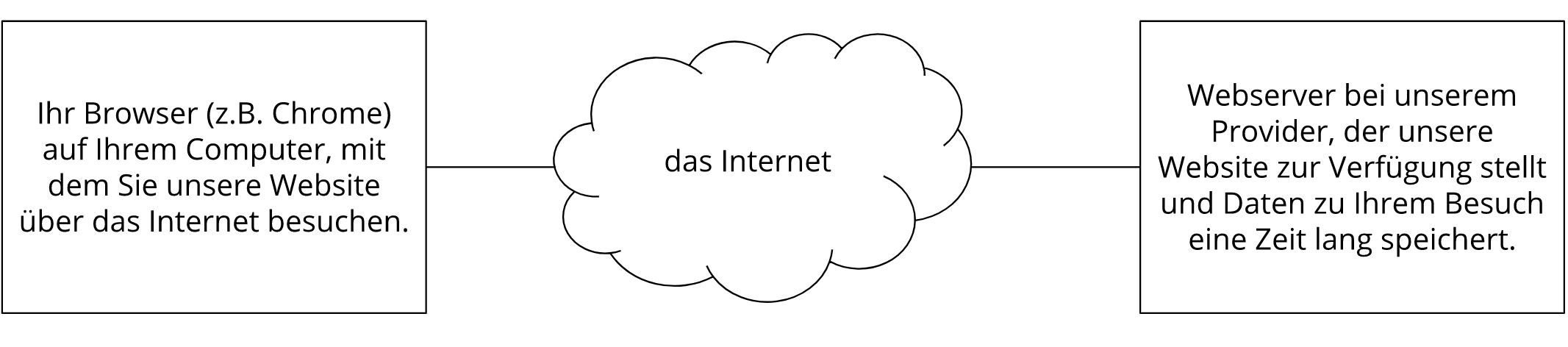
When your browser on your computer (desktop, laptop, smartphone) establishes a connection and during the transfer of data to and from the web server, personal data may be processed. On the one hand, your computer stores data; on the other hand, the web server must also store data for a certain period to ensure proper operation. For illustration, see the following image:
Why do we process personal data?
The purposes of data processing are:
- Professional hosting of the website and ensuring secure operation.
- to maintain operational and IT security.
- Anonymous analysis of access behavior to improve our services and, where applicable, for law enforcement or the enforcement of claims.
Which data is processed?
- the full internet address (URL) of the accessed website (e.g. [https://www.examplewebsite.com/example-subpage.html?tid=321293269]
- browser and browser version (e.g. Chrome 87)
- the operating system used (e.g. Windows 10)
- the address (URL) of the previously visited page (referrer URL) (e.g. [https://www.example-source-site.com/fromwhereicame.html/]
- the hostname and IP address of the device from which access is made (e.g. COMPUTERNAME and 194.23.43.121)
- date and time
- in files, the so-called web server log files
How long is data stored?
As a rule, the data mentioned above is stored for two weeks and then automatically deleted. We do not share this data; however, we cannot rule out that it may be accessed by authorities in the event of unlawful conduct.
In short: your visit is logged by our provider (the company that hosts our website on special computers (servers)), but we do not pass on your data without consent!
Legal basis
The lawfulness of the processing of personal data in the context of web hosting is based on Article 6(1)(f) GDPR (legitimate interests), as the use of professional hosting by a provider is necessary to present the company on the internet in a secure and user-friendly manner and, if necessary, to pursue attacks and related claims.
Cookies
|
Cookies summary 👥 Data subjects: Website visitors 🤝 Purpose: depends on the respective cookie. More details can be found below or with the software provider that sets the cookie. 📓 Processed data: depends on the respective cookie used. More details can be found below or with the software provider that sets the cookie. 📅Retention period: depends on the respective cookie and may range from a few hours to several years. ⚖️ Legal basis: Article 6(1)(a) GDPR (consent), Article 6(1)(f) GDPR (legitimate interests).What are cookies? |
Our website uses HTTP cookies to store user-specific data. In the following, we explain what cookies are and why they are used so that you can better understand the following privacy policy.
Whenever you browse the internet, you use a browser. Well-known browsers include Chrome, Safari, Firefox, Internet Explorer, and Microsoft Edge. Most websites store small text files in your browser. These files are called cookies.
One thing cannot be denied: cookies are really useful helpers. Almost all websites use cookies. More precisely, these are HTTP cookies, as there are also other types of cookies for different applications. HTTP cookies are small files stored on your computer by our website. These cookie files are automatically placed in the cookie folder, essentially the “brain” of your browser. A cookie consists of a name and a value. When defining a cookie, one or more additional attributes must also be specified.
Cookies store certain user data, such as language or personal page settings. When you visit our website again, your browser sends the “user-related” information back to our site. Thanks to cookies, our website knows who you are and provides you with the settings you are used to. In some browsers, each cookie is stored in its own file, while in others, such as Firefox, all cookies are stored in a single file.
The following graphic shows a possible interaction between a web browser such as Chrome and the web server. In this process, the web browser requests a website and receives a cookie from the server, which the browser then reuses when another page is requested.
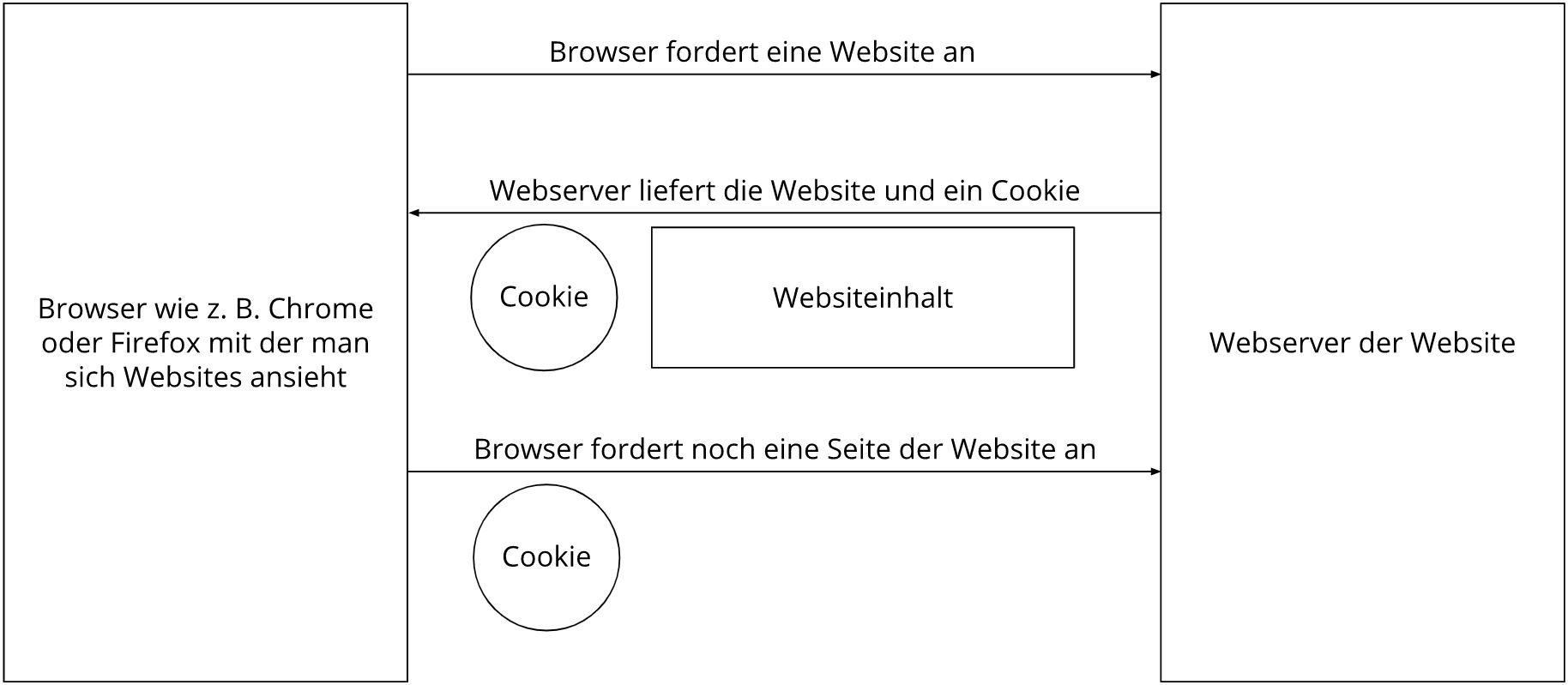
There are both first-party cookies and third-party cookies. First-party cookies are created directly by our website, while third-party cookies are created by partner websites (e.g. Google Analytics). Each cookie must be evaluated individually, as each cookie stores different data. The expiration time of a cookie also varies from a few minutes to several years. Cookies are not software programs and do not contain viruses, trojans, or other “malware”. Cookies also cannot access information on your PC.
For example, cookie data may look like this:
|
These minimum sizes should be supported by a browser:
- At least 4096 bytes per cookie
- At least 50 cookies per domain
- At least 3000 cookies in total
What types of cookies are there?
The question of which cookies we use specifically depends on the services used and is explained in the following sections of the privacy policy. At this point, we would like to briefly explain the different types of HTTP cookies.
There are four types of cookies:
Essential cookies
These cookies are necessary to ensure basic website functions. For example, these cookies are required when a user adds a product to the shopping cart, then continues browsing other pages and only proceeds to checkout later. Thanks to these cookies, the shopping cart is not deleted, even if the user closes their browser window.
Functional cookies
These cookies collect information about user behavior and whether the user receives any error messages. They are also used to measure loading time and the website’s performance across different browsers.
Targeting cookies
These cookies improve user experience. For example, entered locations, font sizes, or form data are stored.
Advertising cookies
These cookies are also called targeting cookies. They are used to deliver individually tailored advertising to the user. This can be very useful, but also quite annoying.
Typically, when you first visit a website, you are asked which of these types of cookies you want to allow. And of course, this decision is also stored in a cookie.
If you would like to learn more about cookies and are not afraid of technical documentation, we recommend https://tools.ietf.org/html/rfc6265the Internet Engineering Task Force (IETF) Request for Comments titled “HTTP State Management Mechanism”.
Purpose of processing via cookies
The purpose ultimately depends on the respective cookie. More details can be found below or with the software provider that sets the cookie.
Which data is processed?
Cookies are small helpers for many different tasks. Unfortunately, it is not possible to generalize what data is stored in cookies, but within this privacy policy we will inform you about the data that is processed or stored.
Storage duration of cookies
You also have control over the storage duration yourself. You can manually delete all cookies at any time via your browser (see also “Right to object” below). In addition, cookies based on consent are deleted at the latest after you withdraw your consent, although the lawfulness of storage up to that point remains unaffected.
Right to object – how can I delete cookies?
You decide yourself how and whether you want to use cookies. Regardless of which service or website the cookies come from, you always have the option to delete, deactivate, or only partially allow cookies. For example, you can block third-party cookies but allow all other cookies.
If you want to see which cookies are stored in your browser, or if you want to change or delete cookie settings, you can find this in your browser settings:
- Chrome: Delete, enable, and manage cookies in Chrome
- Safari: Manage cookies and webiste data in Safari
- Firefox: Delete cookies to remove data that websites have stored on your Computer
- Internet Explorer: Delete and manage cookies
- Microsoft Edge: Delete and manage cookies
If you generally do not want cookies, you can configure your browser to always notify you when a cookie is about to be set. This allows you to decide for each individual cookie whether to allow it or not. The procedure varies depending on the browser. It is best to search for instructions on Google using the search terms “delete cookies Chrome” or “disable cookies Chrome” in the case of the Chrome browser.
Legal basis
Since 2009, there have been so-called “cookie guidelines.” These state that storing cookies requires your consent (Article 6(1)(a) GDPR). However, EU member states have reacted differently to these guidelines. In Austria, this directive was implemented in Section 96(3) of the Telecommunications Act (TKG). In Germany, the cookie guidelines were not implemented as national law. Instead, the directive was largely implemented in Section 15(3) of the Telemedia Act (TMG).
For strictly necessary cookies, even where no consent is given, there are legitimate interests (Article 6(1)(f) GDPR), which are in most cases of an economic nature. We aim to provide website visitors with a pleasant user experience, and for this purpose certain cookies are often absolutely necessary.
To the extent that non-essential cookies are used, this is done only with your consent. The legal basis for this is Article 6(1)(a) GDPR.
In the following sections, you will be informed in more detail about the use of cookies, provided that the software used employs cookies.
Amazon Web Services (AWS) Privacy Policy
We use Amazon Web Services (AWS) for our website, among other things as a web hosting provider. The service provider is the US company Amazon Web Services, Inc., 410 Terry Avenue North, Seattle, WA 98109, USA.
We would like to point out that, according to the European Court of Justice, there is currently no adequate level of data protection for data transfers to the USA. The data processing is carried out primarily by Amazon Web Services (AWS). This may result in data not being processed and stored in anonymized form. Furthermore, US government authorities may potentially gain access to individual data. It may also happen that this data is linked with data from other Amazon services for which you hold a user account.
More information about the data processed through the use of Amazon Web Services (AWS) can be found in the privacy policy at https://aws.amazon.com/de/privacy/ .
Facebook Pixel Privacy Policy
We use the Facebook Pixel from Facebook on our website. For this purpose, we have implemented a code on our website. The Facebook Pixel is a piece of JavaScript code that loads a set of functions that allow Facebook to track your user actions, provided you have reached our website via Facebook ads. For example, if you purchase a product on our website, the Facebook Pixel is triggered and stores your actions on our website in one or more cookies. These cookies allow Facebook to match your user data (customer data such as IP address, user ID) with the data from your Facebook account. Facebook then deletes this data again. The data collected is anonymous to us and not visible to us, and is used only for the purpose of serving advertisements. If you are a Facebook user and are logged in, your visit to our website is automatically assigned to your Facebook user account.
We only want to show our services and products to people who are genuinely interested in them. With the help of the Facebook Pixel, our advertising measures can be better tailored to your wishes and interests. This means that Facebook users (provided they have allowed personalized advertising) are shown relevant ads. Facebook also uses the collected data for analysis purposes and its own advertising activities.
In the following, we show you the cookies that are set by integrating the Facebook Pixel on a test page. Please note that these are only example cookies. Depending on your interaction with our website, different cookies may be set.
|
Note: The cookies listed above relate to individual user behavior. In particular, when using cookies, changes by Facebook can never be ruled out.
If you are logged in to Facebook, you can manage your ad preferences at https://www.facebook.com/ads/preferences/?entry_product=ad_settings_screen change them yourself. If you are not a Facebook user, you can visit http://www.youronlinechoices.com/de/praferenzmanagement/ in general manage your interest-based online advertising. There you have the option to activate or deactivate providers.
We would like to point out that, according to the European Court of Justice, there is currently no adequate level of data protection for data transfers to the USA. The data processing is carried out primarily through the Facebook Pixel. This may result in data not being processed and stored in anonymized form. Furthermore, US government authorities may potentially gain access to individual data. It may also happen that this data is linked with data from other Facebook services for which you hold a user account.
If you would like to learn more about Facebook’s data protection, we recommend the company’s own privacy policy at https://www.facebook.com/policy.php.
Google Analytics Privacy Policy
|
Google Analytics Privacy Policy – Summary 👥 Data subjects: Website visitors 🤝 Purpose: Analysis of visitor information to optimize the website offering. 📓 Processed data: Access statistics that include data such as access locations, device data, access duration and time, navigation behavior, click behavior, and IP addresses. More details can be found further below in this privacy policy. 📅 Retention period: depends on the properties used. ⚖️ Legal basis: Article 6(1)(a) GDPR (consent), Article 6(1)(f) GDPR (legitimate interests). |
What is Google Analytics?
We use the analytics tracking tool Google Analytics (GA) from the US company Google Inc. on our website. For the European region, Google Ireland Limited (Gordon House, Barrow Street, Dublin 4, Ireland) is responsible for all Google services. Google Analytics collects data about your actions on our website. For example, if you click on a link, this action is stored in a cookie and sent to Google Analytics. Using the reports we receive from Google Analytics, we can better adapt our website and services to your needs. In the following, we explain the tracking tool in more detail and inform you in particular about which data is stored and how you can prevent this.
Google Analytics is a tracking tool used for traffic analysis of our website. In order for Google Analytics to work, a tracking code is embedded in the code of our website. When you visit our website, this code records various actions that you perform on our website. As soon as you leave our website, this data is sent to Google Analytics servers and stored there.
Google processes the data and we receive reports about your user behavior. These reports may include, among others, the following:
-
Audience reports: Audience reports help us better understand our users and provide insights into who is interested in our service.
-
Advertising reports: Advertising reports allow us to more easily analyze and improve our online advertising.
-
Acquisition reports: Acquisition reports provide us with useful information on how we can attract more people to our service.
-
Behavior reports: Here we learn how you interact with our website. We can track the path you take on our site and which links you click.
-
Conversion reports: A conversion is a process in which you perform a desired action in response to a marketing message. For example, when you turn from a simple website visitor into a buyer or newsletter subscriber. These reports help us better understand how our marketing measures are received by you. In this way, we aim to increase our conversion rate.
-
Real-time reports: Here we can immediately see what is currently happening on our website. For example, we can see how many users are currently reading this text.
Why do we use Google Analytics on our website?
Our goal with this website is clear: we want to provide you with the best possible service. The statistics and data from Google Analytics help us achieve this goal.
The statistically evaluated data provides us with a clear picture of the strengths and weaknesses of our website. On the one hand, we can optimize our site so that it is more easily found by interested users on Google. On the other hand, the data helps us better understand you as a visitor. This allows us to know very precisely what we need to improve on our website in order to provide you with the best possible service. The data also helps us carry out our advertising and marketing measures in a more targeted and cost-effective way. Ultimately, it only makes sense to show our products and services to people who are actually interested in them.
What data is stored by Google Analytics?
Google Analytics creates a random, unique ID using a tracking code, which is linked to your browser cookie. This allows Google Analytics to identify you as a new user. When you visit our website again, you are recognized as a “returning” user. All collected data is stored together with this user ID. This makes it possible to analyze pseudonymous user profiles.
To analyze our website using Google Analytics, a Property ID must be inserted into the tracking code. The data is then stored in the corresponding property. For every newly created property, the Google Analytics 4 property is used by default. Alternatively, a Universal Analytics property can still be created. Depending on the property used, data is stored for different periods of time.
Through identifiers such as cookies and app instance IDs, your interactions on our website are measured. Interactions include all types of actions you perform on our website. If you also use other Google systems (such as a Google Account), data generated through Google Analytics may be linked with third-party cookies. Google does not share Google Analytics data unless we, as the website operator, authorize it. Exceptions may apply where required by law.
|
The following cookies are used by Google Analytics:
Name: _ga
Name: _gid
Name: _gat_gtag_UA_<property-id>
Name: AMP_TOKEN
Name: __utma
Name: __utmt
Name: __utmb
Name: __utmc
Name: __utmz
Name: __utmv |
Note: This list cannot claim to be exhaustive, as Google regularly changes its choice of cookies.
Here we provide an overview of the most important data collected with Google Analytics:
Heatmaps: Google creates so-called heatmaps. Heatmaps show exactly which areas you click on. This provides us with information about where you “move” on our website.
Session duration: Google defines session duration as the amount of time you spend on our site without leaving the page. If you are inactive for 20 minutes, the session ends automatically.
Bounce rate: A bounce occurs when you view only one page on our website and then leave the site again.
Account creation: If you create an account on our website or place an order, Google Analytics collects this data.
IP address: The IP address is only displayed in a truncated form so that no unique identification is possible.
Location: The country and your approximate location can be determined via the IP address. This process is also known as IP-based geolocation.
Technical information: This includes, among other things, your browser type, internet service provider, and screen resolution.
Traffic source: Google Analytics—and of course we are also interested in which website or advertisement you used to reach our site.
Other data includes contact details, any ratings, media playback (e.g., if you play a video on our website), sharing content via social media, or adding items to your favorites. This list does not claim to be exhaustive and is intended only to provide a general overview of data storage by Google Analytics.
How long and where is the data stored?
Google has its servers distributed around the world. Most servers are located in the United States, and therefore your data is usually stored on American servers. You can find exactly where Google's data centers are located here: [https://www.google.com/about/datacenters/inside/locations/?hl=de](https://www.google.com/about/datacenters/inside/locations/?hl=de)
Your data is distributed across different physical storage devices. This has the advantage that the data can be accessed more quickly and is better protected against manipulation. Each Google data center has appropriate emergency programs for your data. For example, if Google’s hardware fails or natural disasters disable servers, the risk of service disruption at Google remains low.
The retention period of the data depends on the properties used. When using the newer Google Analytics 4 properties, the retention period for your user data is set to 14 months. For other so-called event data, we can choose a retention period of either 2 months or 14 months.
For Universal Analytics properties, Google Analytics has a standard retention period of 26 months for your user data. After that, your user data is deleted. However, we have the option to choose the retention period for user data ourselves. There are five options available for this:
-
Deletion after 14 months
-
Deletion after 26 months
-
Deletion after 38months
-
Deletion after 50months
-
No automatic deletion
Additionally, there is also the option that data is only deleted if you do not visit our website again within the period we have selected. In this case, the retention period is reset each time you visit our website again within the specified timeframe.
Once the defined period has expired, the data is deleted once per month. This retention period applies to your data linked to cookies, user identification, and advertising IDs (e.g., cookies from the DoubleClick domain). Reporting results are based on aggregated data and are stored independently of user data. Aggregated data is a combination of individual data into a larger unit.
How can I delete my data or prevent data storage?
According to the data protection law of the European Union, you have the right to access, update, delete, or restrict your data. By using the browser add-on to disable Google Analytics JavaScript (ga.js, analytics.js, dc.js), you can prevent Google Analytics from using your data. You can download and install the browser add-on at [https://tools.google.com/dlpage/gaoptout?hl=de](https://tools.google.com/dlpage/gaoptout?hl=de) Please note that this add-on only disables data collection by Google Analytics.
If you generally want to disable, delete, or manage cookies (regardless of Google Analytics), there are separate instructions for each browser:
Chrome:
Delete, enable and manage cookies in Chrome
Safari:
Manage cookies and website data with safari
Firefox:
Delete cookies to remove data that websites have stored on your Computer
Internet Explorer:
Delete and manage cookies
Microsoft Edge:
Delete and manage cookies
Legal basis
The use of Google Analytics requires your consent, which we obtain via our cookie pop-up. This consent constitutes, in accordance with Art. 6(1)(a) GDPR (consent), the legal basis for the processing of personal data, as may occur in the collection by web analytics tools.
In addition to consent, we have a legitimate interest in analyzing the behavior of website visitors in order to improve our services technically and economically. With the help of Google Analytics, we can identify website errors, detect attacks, and improve efficiency. The legal basis for this is Art. 6(1)(f) GDPR (legitimate interests). However, we only use Google Analytics if you have given your consent.
Google also processes data in the United States, among other countries. We would like to point out that, according to the European Court of Justice, there is currently no adequate level of protection for data transfers to the USA. This may be associated with various risks regarding the legality and security of data processing.
As the basis for data processing with recipients based in third countries (outside the European Union, Iceland, Liechtenstein, and Norway, in particular the United States) or for data transfers to such countries, Google uses Standard Contractual Clauses approved by the European Commission (Art. 46(2) and (3) GDPR). These clauses oblige Google to comply with the EU data protection level when processing relevant data outside the EU. These clauses are based on an implementing decision of the European Commission. You can find the decision and the clauses here: https://ec.europa.eu/germany/news/20210604-datentransfers-eu_de.
We hope we have been able to provide you with the most important information regarding data processing by Google Analytics. If you would like to learn more about this tracking service, we recommend the following two links:
http://www.google.com/analytics/terms/de.html und https://support.google.com/analytics/answer/6004245?hl=de.
Google Analytics IP-Anonymisierung
We have implemented IP anonymization in Google Analytics on this website. This feature was developed by Google to help this website comply with applicable data protection regulations and recommendations from local data protection authorities when they prohibit the storage of full IP addresses. IP anonymization takes place as soon as the IP addresses reach the Google Analytics data collection network and before any storage or processing of the data occurs. More information about IP anonymization can be found at [https://support.google.com/analytics/answer/2763052?hl=de](https://support.google.com/analytics/answer/2763052?hl=de).
Google Analytics reports on demographic characteristics and interests
We have enabled advertising reporting features in Google Analytics. The reports on demographic characteristics and interests include information on age, gender, and interests. This allows us to gain a better understanding of our users—without being able to assign this data to individual persons. You can learn more about the advertising features at https://support.google.com/analytics/answer/3450482?hl=de_AT&utm_id=ad.
You can manage the use of your Google Account activity and information under “Ad Settings” at https://adssettings.google.com/authenticated per Checkbox beenden.
Google Analytics Addendum to Data Processing
We have concluded a direct customer contract with Google for the use of Google Analytics by accepting the “Data Processing Addendum” in Google Analytics. More information about the Data Processing Addendum for Google Analytics can be found here: https://support.google.com/analytics/answer/3379636?hl=de&utm_id=ad
Google Tag Manager Privacy Policy
|
Google Tag Manager Privacy Policy Summary:
👥 Affected: Website visitors |
What is Google Tag Manager?
For our website, we use Google Tag Manager from Google Inc. For the European region, Google Ireland Limited (Gordon House, Barrow Street, Dublin 4, Ireland) is responsible for all Google services. This Tag Manager is one of many useful marketing products from Google. With Google Tag Manager, we can centrally integrate and manage code snippets from various tracking tools that we use on our website.
In this privacy policy, we would like to explain in more detail what Google Tag Manager does, why we use it, and in what form data is processed.
Google Tag Manager is an organizational tool that allows us to integrate and manage website tags centrally via a user interface. Tags are small code snippets that, for example, record (track) your activities on our website. For this purpose, JavaScript code snippets are inserted into the source code of our site. The tags often come from Google products such as Google Ads or Google Analytics, but tags from other companies can also be integrated and managed via the manager. Such tags perform different tasks. They can collect browser data, supply marketing tools with data, embed buttons, set cookies, and also track users across multiple websites.
Why do we use Google Tag Manager for our website?
As the saying goes: organization is half the battle! And this also applies to maintaining our website. In order to design our website as well as possible for you and for everyone interested in our products and services, we use various tracking tools such as Google Analytics. The data collected by these tools shows us what interests you most, where we can improve our services, and which people we should also present our offers to. And for this tracking to work, we need to integrate corresponding JavaScript codes into our website. In principle, we could integrate each code snippet from the individual tracking tools separately into our source code. However, this requires quite a lot of time and it is easy to lose track. That is why we use Google Tag Manager. We can easily integrate the necessary scripts and manage them from one place. In addition, Google Tag Manager provides an easy-to-use interface and no programming knowledge is required. This helps us keep order in our tag jungle.
What data is stored by Google Tag Manager?
The Tag Manager itself is a domain that does not set cookies and does not store any data. It functions solely as a “manager” of the implemented tags. The data is collected by the individual tags of the various web analytics tools. The data is essentially passed through the Google Tag Manager to the respective tracking tools and is not stored there.
The situation is quite different with the embedded tags of various web analytics tools, such as Google Analytics. Depending on the analytics tool, different data about your web behavior is usually collected, stored, and processed with the help of cookies. For this reason, please refer to our privacy policy texts for the individual analysis and tracking tools we use on our website.
In the account settings of the Tag Manager, we have allowed Google to receive anonymized data from us. However, this only concerns the use of our Tag Manager and not your data that is stored via the code snippets. We enable Google and others to receive selected data in anonymized form. We therefore agree to the anonymous sharing of our website data. We were unable to determine exactly which aggregated and anonymized data is shared, despite extensive research. In any case, Google removes all information that could identify our website. Google combines the data with hundreds of other anonymized website datasets and creates user trends as part of benchmarking measures. Benchmarking compares your own results with those of competitors. Based on the collected information, processes can be optimized.
How long and where is the data stored?
When Google stores data, it is stored on Google’s own servers. These servers are distributed around the world. Most of them are located in the United States. At https://www.google.com/about/datacenters/inside/locations/?hl=de you can find out exactly where Google’s servers are located.
How long individual tracking tools store your data can be found in our specific privacy information for each respective tool.
How can I delete my data or prevent data storage?
The Google Tag Manager itself does not set any cookies but manages tags from various tracking services. In our privacy information for the individual tracking tools, you will find detailed information on how to delete or manage your data.
Please note that when using this tool, your data may also be stored and processed outside the European Union. Most third countries (including the United States) are currently not considered secure under European data protection law. Therefore, data may not simply be transferred to, stored in, or processed in such countries unless appropriate safeguards (such as EU Standard Contractual Clauses) are in place between us and the non-European service provider.
Legal basis
The use of Google Tag Manager requires your consent, which we obtain through our cookie consent banner. According to Article 6(1)(a) GDPR (consent), this consent serves as the legal basis for the processing of personal data, as may occur when data is collected through web analytics tools.
In addition to your consent, we also have a legitimate interest in analyzing the behavior of website visitors in order to improve our services both technically and economically. With the help of Google Tag Manager, we can enhance the efficiency and effectiveness of our website operations. The legal basis for this is Article 6(1)(f) GDPR (legitimate interests). Nevertheless, we only use Google Tag Manager if you have provided your consent.
Google also processes data in the United States, among other countries. We would like to point out that, according to the European Court of Justice, there is currently no adequate level of protection for data transfers to the USA. This may be associated with various risks regarding the legality and security of data processing.
As the basis for data processing with recipients based in third countries (outside the European Union, Iceland, Liechtenstein, and Norway, in particular the United States) or for data transfers to such countries, Google uses Standard Contractual Clauses approved by the European Commission (Art. 46(2) and (3) GDPR). These clauses oblige Google to comply with the EU data protection level when processing relevant data outside the EU. These clauses are based on an implementing decision of the European Commission. You can find the decision and the clauses here: https://ec.europa.eu/germany/news/20210604-datentransfers-eu_de.
If you would like to learn more about Google Tag Manager, we recommend reviewing the FAQs available at Google’s official website.
https://www.google.com/intl/de/tagmanager/faq.html.
Google Analytics Google Signals Privacy Policy
We have activated Google Signals in Google Analytics. This updates the existing Google Analytics features (advertising reports, remarketing, cross-device reports, and reports on interests and demographic characteristics) to receive aggregated and anonymized data from you, provided that you have enabled personalized ads in your Google Account.
The special thing about this is that it is cross-device tracking. This means your data can be analyzed across different devices. By enabling Google Signals, data is collected and linked to your Google account. This allows Google, for example, to recognize when you view a product on our website via a smartphone and later purchase the product using a laptop. Thanks to the activation of Google Signals, we can run cross-device remarketing campaigns that would not otherwise be possible in this form. Remarketing means that we can also show you our offers on other websites.
In Google Analytics, additional visitor data is also collected through Google Signals, such as location, search history, YouTube history, and data about your actions on our website. This provides us with better advertising reports and more useful information about your interests and demographic characteristics. This includes your age, the language you speak, where you live, or your gender. In addition, social criteria such as your occupation, marital status, or income may also be included. All of these characteristics help Google Analytics define groups of people or target audiences.
These reports also help us better understand your behavior, wishes, and interests. This allows us to optimize and tailor our services and products for you. This data expires by default after 26 months. Please note that this data collection only takes place if you have enabled personalized advertising in your Google Account. The data is always aggregated and anonymized and never refers to individual persons. You can manage or delete this data in your Google Account.
E-Mail-Marketing
|
Email marketing summary:
👥 Data subjects: newsletter subscribers |
What is E-Mail-Marketing?
To keep you up to date at all times, we also use email marketing. If you have consented to receive our emails or newsletters, your data will also be processed and stored. Email marketing is a sub-area of online marketing. It involves sending news or general information about a company, products, or services via email to a specific group of people who are interested in them.
If you want to participate in our email marketing (usually via newsletter), you normally just need to register with your email address. To do so, you fill out an online form and submit it. However, it may also happen that we ask you for your salutation and your name so that we can address you personally.
In general, subscribing to newsletters works using the so-called “double opt-in” procedure. After you have signed up for our newsletter on our website, you will receive an email in which you must confirm your subscription. This ensures that the email address belongs to you and that no one has registered using a third-party email address. We, or a notification tool used by us, log each individual registration. This is necessary in order to be able to prove a legally correct registration process. In doing so, the time of registration, the time of confirmation, and your IP address are usually stored. In addition, any changes you make to your stored data are also recorded.
Why do we use email marketing?
Why do we use email marketing? We naturally want to stay in contact with you and always present the most important news about our company. For this purpose, we use email marketing—often also referred to simply as a “newsletter”—as an essential part of our online marketing. If you agree or if it is legally permitted, we will send you newsletters, system emails, or other email notifications. When we use the term “newsletter” in the following text, we mainly mean regularly sent emails. Of course, we do not want to bother you with our newsletters. That is why we always strive to provide only relevant and interesting content. This way, you can learn more about our company, our services, or our products. Since we are constantly improving our offerings, our newsletter also keeps you informed about news or special attractive promotions. If we use a service provider that offers a professional email distribution tool for our email marketing, we do so in order to provide you with fast and secure newsletters. The purpose of our email marketing is generally to inform you about new offers and to help us achieve our business objectives.
Which data is processed?
If you subscribe to our newsletter via our website, you confirm your membership in an email list by email. In addition to your IP address and email address, your salutation, name, address, and telephone number may also be stored. However, this only happens if you consent to this data storage. The data marked as such is necessary in order for you to participate in the offered service. Providing this information is voluntary, but if you do not provide it, you will not be able to use the service. In addition, information about your device or your preferred content on our website may also be stored. More information about data storage when visiting a website can be found in the section “Automatic data storage”. We also record your consent declaration so that we can always prove that it complies with legal requirements.
Duration of data processing
If you unsubscribe your email address from our email/newsletter mailing list, we may store your address for up to three years based on our legitimate interests in order to be able to prove your prior consent. We are only allowed to process this data if we need to defend ourselves against any potential claims.
However, if you confirm that you have given us your consent to subscribe to the newsletter, you may submit an individual request for deletion at any time. If you permanently withdraw your consent, we reserve the right to store your email address on a blocklist. As long as you voluntarily subscribe to our newsletter, we will of course retain your email address.
Right to object
You have the possibility to cancel your newsletter subscription at any time. To do so, you simply need to withdraw your consent to receive the newsletter. In most cases, this only takes a few seconds or one or two clicks. You will usually find a link to unsubscribe directly at the end of each email. If you cannot find the unsubscribe link in the newsletter, please contact us by email and we will immediately cancel your subscription.
Legal basis
The sending of our newsletter is based on your consent (Article 6(1)(a) GDPR). This means that we may only send you a newsletter if you have previously actively subscribed to it. In some cases, we may also send you advertising messages based on Section 7(3) UWG, provided you have become our customer and have not objected to the use of your email address for direct marketing.
Information on specific email marketing services and how they process personal data can be found – where available – in the following sections.
Push notifications
|
Push notifications summary:
👥 Data subjects: push notification subscribers |
What are push notifications?
We also use so-called push notification services on our website to keep our users up to date at all times. This means that if you have consented to the use of such push notifications, we can send you short news messages using a software tool. Push notifications are a form of text message that appears directly on your smartphone or other devices such as tablets or PCs once you have subscribed to them. You will receive these messages even if you are not on our website or actively using our services. In this process, data about your location and your usage behavior may also be collected and stored.
Why do we use push notifications?
On the one hand, we use push notifications to be able to fully provide the services we have contractually agreed with you. On the other hand, the messages also serve our online marketing purposes. With the help of these notifications, we can introduce you to our services or products. Especially when there are news or updates in our company, we can inform you immediately. We aim to better understand the preferences and habits of all our users in order to continuously improve our offering.
Which data is processed?
In order for you to receive push notifications, you must also confirm that you wish to receive these messages. The data collected during the consent process is also stored, managed, and processed. This is necessary to prove and verify that a user has agreed to receive push notifications. For this purpose, a so-called device token or push token is stored in your browser. Usually, data about your location or the location of your device is also stored.
In order to ensure that we also send relevant and important push notifications, the handling of these messages is statistically analyzed. For example, this allows us to see whether and when you open a message. With the help of these insights, we can adapt our communication strategy to your wishes and interests. Although the stored data can be assigned to you, we do not intend to identify you as an individual. Rather, we are interested in the aggregated data of all our users in order to make improvements. Which exact data is stored can be found in the privacy policies of the respective service providers.
Duration of data processing
The duration for which data is processed and stored primarily depends on the tool we use. Further below, you will find more information about the data processing of the individual tools. In the privacy policies of the providers, it is usually specified in detail which data is stored and for how long it is processed. In general, personal data is only processed for as long as it is necessary to provide our services. If data is stored in cookies, the storage duration can vary significantly. Data may be deleted immediately after leaving a website, but it can also be stored for several years. Therefore, you should review each individual cookie in detail if you want to learn more about data storage. In most cases, the privacy policies of the respective providers also contain detailed information about individual cookies.
Legal basis
It is also possible that push notifications are necessary to fulfill certain obligations set out in a contract. For example, to inform you about technical or organizational updates. In this case, the legal basis is Art. 6(1)(b) GDPR.
If this is not the case, push notifications are sent solely on the basis of your consent. In particular, our push notifications may contain promotional content. Push notifications may also be sent depending on the location displayed by your device. The analytical evaluations mentioned above are likewise based on your consent to receive such notifications. The legal basis in this respect is Art. 6(1)(a) GDPR. Of course, you may withdraw your consent at any time or change various settings in your device settings.
Online-Marketing
|
Online Marketing Privacy Policy Summary:
👥 Data subjects: Website visitors |
What is Online-Marketing?
Online marketing refers to all measures carried out online to achieve marketing goals such as increasing brand awareness or completing a business transaction. Furthermore, our online marketing activities aim to draw attention to our website. In order to present our offer to as many interested people as possible, we therefore engage in online marketing. This usually involves online advertising, content marketing, or search engine optimization. To enable us to use online marketing efficiently and in a targeted manner, personal data is also stored and processed. On the one hand, this data helps us to display our content only to those individuals who are actually interested in it, and on the other hand, it allows us to measure the success of our online marketing measures.
Why do we use online marketing tools?
We want to show our website to everyone who is interested in our offer. We are aware that this is not possible without deliberate measures. That is why we engage in online marketing. There are various tools that make it easier for us to carry out our online marketing activities and also continuously provide data-based suggestions for improvement. This allows us to target our campaigns more precisely to our audience. The purpose of the online marketing tools we use is ultimately to optimize our offering.
Which data is processed?
In order for our online marketing to function and for the success of our measures to be measured, user profiles are created and data is stored, for example in cookies (which are small text files). With the help of this data, we can not only display advertising in the traditional sense, but also present our content directly on our website in a way that best suits you. For this purpose, various third-party tools are used that provide these functions and also collect and store data from you. The cookies mentioned, for example, store which pages you have visited on our website, how long you viewed those pages, which links or buttons you clicked, or which website you came from. In addition, technical information may also be stored, such as your IP address, which browser you use, which device you access our website from, or the time when you accessed and left our website. If you have consented to us determining your location, we may also store and process this information.
Your IP address is stored in pseudonymized form (i.e., shortened). Unique data that directly identifies you as a person, such as your name, address, or email address, is also only stored in pseudonymized form within advertising and online marketing processes. This means that we cannot identify you as a person; we only store pseudonymized information in the user profiles.
The cookies may, under certain circumstances, also be used, analyzed, and processed for advertising purposes on other websites that work with the same advertising tools. The data may also be stored on the servers of the advertising tool providers.
In exceptional cases, unique data (such as names, email addresses, etc.) may also be stored in user profiles. This may occur, for example, if you are a member of a social media channel that we use for our online marketing activities and the network links previously collected data with the user profile.
For all advertising tools we use that store data on their servers, we only ever receive aggregated information and never data that would make you identifiable as an individual. The data merely shows how effective the advertising measures were. For example, we can see which measures led you or other users to visit our website and purchase a service or product there. Based on these analyses, we can improve our advertising offering in the future and tailor it even more precisely to the needs and wishes of interested individuals.
Duration of data processing
We will inform you below about the duration of data processing, provided we have further information on this. In general, we only process personal data for as long as it is strictly necessary to provide our services and products. Data stored in cookies is kept for varying periods of time. Some cookies are deleted as soon as you leave the website, while others may remain stored in your browser for several years. In the respective privacy policies of the individual providers, you will usually find detailed information about the specific cookies used by the provider.
Right to object
You also have the right and the option to withdraw your consent to the use of cookies or third-party providers at any time. This can be done either via our cookie management tool or through other opt-out functions. For example, you can also prevent data collection through cookies by managing, disabling, or deleting cookies in your browser. The lawfulness of processing carried out up to the time of withdrawal remains unaffected.
Since online marketing tools generally use cookies, we also recommend reading our general cookie privacy policy. To find out exactly which data is stored and processed about you, you should review the privacy policies of the respective tools.
Legal basis
If you have consented to the use of third-party providers, the legal basis for the corresponding data processing is this consent. According to Art. 6(1)(a) GDPR (consent), this consent constitutes the legal basis for the processing of personal data, as may occur in the collection of data by online marketing tools.
In addition, we have a legitimate interest in measuring online marketing measures in an anonymized form in order to optimize our services and activities based on the data obtained. The corresponding legal basis for this is Art. 6(1)(f) GDPR (legitimate interests). However, we only use these tools insofar as you have given your consent.
Information on specific online marketing tools can be found – where available – in the following sections.
Facebook Conversions API Privacy Policy Summary
We use Facebook Conversions API on our website, a server-side event tracking tool. The service provider is the American company Facebook Inc. For the European region, the company Facebook Ireland Ltd. (4 Grand Canal Square, Grand Canal Harbour, Dublin 2, Ireland) is responsible.
Facebook Conversions API also processes data in the United States, among other locations. We would like to point out that, according to the opinion of the European Court of Justice, there is currently no adequate level of data protection for data transfers to the USA. This may be associated with various risks regarding the lawfulness and security of data processing.
As the legal basis for data processing with recipients based in third countries (outside the European Union, Iceland, Liechtenstein, and Norway – in particular in the USA) or for data transfers to such countries, Facebook Conversions API uses standard contractual clauses approved by the EU Commission (Art. 46(2) and (3) GDPR). These clauses oblige Facebook Conversions API to comply with the EU level of data protection when processing relevant data, even outside the EU. These clauses are based on an implementing decision of the EU Commission. You can find the decision and the clauses here: [https://ec.europa.eu/germany/news/20210604-datentransfers-eu_de](https://ec.europa.eu/germany/news/20210604-datentransfers-eu_de).
More information about the data processed through the use of Facebook Conversions API can be found in the Privacy Policy at [https://www.facebook.com/about/privacy](https://www.facebook.com/about/privacy).
Facebook Custom Audiences Privacy Policy Summary
We use Facebook Custom Audiences on our website, a server-side event tracking tool. The service provider is the American company Facebook Inc. For the European region, the company Facebook Ireland Ltd. (4 Grand Canal Square, Grand Canal Harbour, Dublin 2, Ireland) is responsible.
Facebook also processes data in the United States, among other locations. We would like to point out that, according to the opinion of the European Court of Justice, there is currently no adequate level of data protection for data transfers to the USA. This may be associated with various risks regarding the lawfulness and security of data processing.
As the legal basis for data processing with recipients based in third countries (outside the European Union, Iceland, Liechtenstein, and Norway – in particular in the USA) or for data transfers to such countries, Facebook uses standard contractual clauses approved by the EU Commission (Art. 46(2) and (3) GDPR). These clauses oblige Facebook to comply with the EU level of data protection when processing relevant data, even outside the EU. These clauses are based on an implementing decision of the EU Commission. You can find the decision and the clauses here: https://ec.europa.eu/germany/news/20210604-datentransfers-eu_de.
More information about the data processed through the use of Facebook Custom Audiences can be found in the Privacy Policy at: https://www.facebook.com/about/privacy .
Google Ads (Google AdWords) Conversion Tracking Privacy Policy
|
Google Ads (Google AdWords) Conversion Tracking Privacy Policy Summary
👥 Data subjects: Website visitors |
What is Google Ads Conversion Tracking?
We use Google Ads (formerly Google AdWords) as an online marketing measure to advertise our products and services. In this way, we want to draw more people’s attention online to the high quality of our offerings. As part of our Google Ads advertising measures, we use conversion tracking from the company Google Inc. on our website. In Europe, however, the company Google Ireland Limited (Gordon House, Barrow Street, Dublin 4, Ireland) is responsible for all Google services. With the help of this free tracking tool, we can better adapt our advertising offerings to your interests and needs. In the following article, we would like to explain in more detail why we use conversion tracking, which data is stored, and how you can prevent this data storage.
Google Ads (formerly Google AdWords) is the in-house online advertising system of the company Google Inc. We are convinced of the quality of our offering and want as many people as possible to become familiar with our website. In the online sector, Google Ads provides the best platform for this. Of course, we also want to obtain a clear overview of the cost-benefit ratio of our advertising campaigns. Therefore, we use the Google Ads conversion tracking tool.
But what exactly is a conversion? A conversion occurs when you change from a purely interested website visitor into an active visitor. This happens whenever you click on our advertisement and then carry out another action, such as visiting our website. With Google’s conversion tracking tool, we record what happens after a user clicks on our Google Ads ad. For example, we can see whether products are purchased, services are used, or whether users have signed up for our newsletter.
Why do we use Google Ads Conversion Tracking on our website?
We use Google Ads to draw attention to our offer on other websites as well. The goal is to ensure that our advertising campaigns only reach people who are interested in our offers. With the conversion tracking tool, we can see which keywords, ads, ad groups, and campaigns lead to the desired customer actions. We can see how many customers interact with our ads on a device and then complete a conversion. Based on this data, we can calculate our cost-benefit ratio, measure the success of individual advertising measures, and therefore optimize our online marketing activities. We can also use the collected data to make our website more interesting for you and to tailor our advertising offer even more individually to your needs.
Which data is stored in Google Ads Conversion Tracking?
We have integrated a conversion tracking tag or code snippet on our website in order to better analyze certain user actions. When you click on one of our Google Ads advertisements, the “Conversion” cookie from a Google domain is stored on your computer (usually in your browser) or mobile device. Cookies are small text files that store information on your computer.
|
Here are the data of the most important cookies for Google conversion tracking:
Name: Conversion
Name: _gac |
Note: The _gac cookie appears only in connection with Google Analytics. The above list does not claim to be complete, as Google also uses other cookies for analytical evaluation from time to time.
As soon as you complete an action on our website, Google recognizes the cookie and stores your action as a so-called conversion. As long as you are browsing our website and the cookie has not yet expired, we and Google can recognize that you found us via our Google Ads advertisement. The cookie is read and sent back to Google Ads together with the conversion data. It is also possible that other cookies are used to measure conversions. Google Ads conversion tracking can be further refined and improved with the help of Google Analytics. For ads that Google displays in various places on the web, cookies named “__gads” or “_gac” may be set under our domain. Since September 2017, various campaign information from analytics.js has been stored in the _gac cookie. This cookie stores this data as soon as you visit one of our pages for which Google Ads auto-tagging has been set up. Unlike cookies set for Google domains, Google can only read these conversion cookies when you are on our website. We do not collect or receive any personal data. We receive a report from Google with statistical evaluations. For example, we learn the total number of users who clicked on our ad and we can see which advertising measures were successful.
How long and where is the data stored?
At this point, we would like to point out that we have no influence on how Google further uses the collected data. According to Google, the data is encrypted and stored on secure servers. In most cases, conversion cookies expire after 30 days and do not transmit any personal data. The cookies named “Conversion” and “_gac” (which are used in connection with Google Analytics) have an expiry date of 3 months.
How can I delete my data or prevent data storage?
You have the option of not participating in Google Ads conversion tracking. If you disable the Google conversion tracking cookie in your browser, you block conversion tracking. In this case, you will not be included in the tracking tool’s statistics. You can change your cookie settings in your browser at any time. Each browser works slightly differently. Here you can find instructions on how to manage cookies in your browser:
Chrome:
Delete, enable and manage cookies in Chrome
Safari:
Manage cookies and website data with safari
Firefox:
Delete cookies to remove data that websites have stored on your Computer
Internet Explorer:
Delete and manage cookies
Microsoft Edge:
Delete and manage cookies
If you generally do not want cookies, you can configure your browser so that it always informs you when a cookie is about to be set. This allows you to decide for each individual cookie whether to allow it or not. By downloading and installing this browser plug-in at [https://support.google.com/ads/answer/7395996](https://support.google.com/ads/answer/7395996), all “advertising cookies” are also disabled. Please note that disabling these cookies does not prevent advertisements from being displayed, but only personalized advertising.
Legal basis
If you have consented to the use of Google Ads conversion tracking, the legal basis for the corresponding data processing is this consent. According to Art. 6(1)(a) GDPR (consent), this consent constitutes the legal basis for the processing of personal data, as may occur in the collection through Google Ads conversion tracking.
From our side, we also have a legitimate interest in using Google Ads conversion tracking in order to optimize our online services and marketing measures. The corresponding legal basis for this is Art. 6(1)(f) GDPR (legitimate interests). However, we only use Google Ads conversion tracking insofar as you have given your consent.
Google verarbeitet Daten unter anderem auch in den USA. Wir weisen darauf hin, dass nach Auffassung des Europäischen Gerichtshofs derzeit kein angemessenes Schutzniveau für Datenübermittlungen in die USA besteht. Dies kann verschiedene Risiken hinsichtlich der Rechtmäßigkeit und Sicherheit der Datenverarbeitung mit sich bringen.
As a basis for data processing by recipients located in third countries (outside the European Union, Iceland, Liechtenstein, and Norway, particularly in the USA) or for data transfers to such countries, Google uses Standard Contractual Clauses approved by the European Commission (= Art. 46(2) and (3) GDPR). These clauses oblige Google to comply with the EU level of data protection when processing relevant data, even outside the EU. The clauses are based on an implementing decision of the European Commission. You can find the decision and the clauses, among other places, here: [https://ec.europa.eu/germany/news/20210604-datentransfers-eu_de](https://ec.europa.eu/germany/news/20210604-datentransfers-eu_de).
If you would like to learn more about data protection at Google, we recommend reviewing Google's general Privacy Policy: [https://policies.google.com/privacy?hl=de](https://policies.google.com/privacy?hl=de).
Microsoft Advertising Privacy Policy
|
Microsoft Advertising Privacy Policy Summary:
👥 Affected parties: Website visitors |
What is Microsoft Advertising?
For our online marketing measures, we also use the advertising program Microsoft Advertising from the company Microsoft Corporation, One Microsoft Way, Redmond, WA 98052-6399, USA. With the help of Microsoft Advertising, we aim to draw the attention of many people to the high quality of our products and/or services. For this purpose, we use a technology (conversion tracking tool) from Microsoft on our website that also stores data about you. In this privacy policy, we take a closer look at this service, show you which data is stored, managed, and processed, and how you can prevent this data storage.
You may know Microsoft Advertising better under its former name “Bing Ads.” It is an advertising program from Microsoft that is based on a pay-per-click system. This means that advertisers can place ads via the Bing and Yahoo! search engines and only pay when a user clicks on the ad.
Why do we use Microsoft Advertising?
We are convinced of our offerings and naturally want to present them to a broad audience. With Microsoft Advertising, we can bring our products or services to exactly those people who are genuinely interested in them. We do not want to present our products only on the well-known search engine Google, but also on Bing and Yahoo! With Microsoft Advertising, we also have the possibility to place ads in the so-called “Microsoft Audience Network.” This allows us, for example, to display advertisements on LinkedIn as well. Through conversion tracking, we can learn, for example, which ad you used to find us, which subpages you particularly liked, and which actions you take on our website. With this data, we can adapt our website, our advertisements, and our offers much better to your needs.
Which data is stored by Microsoft Advertising?
We have integrated a conversion tracking tag (i.e. a small code snippet) from Microsoft Advertising into our website. This is the so-called Universal Event Tracking (UET) tag. If you arrive at our website via a Microsoft advertisement, we can use this tracking tool to learn more about your user behavior on our website. For example, we find out which keyword or which ad led you to us, what you click on on our website, how many people visit our website via Microsoft Ads, and how long you stay on our website. All of this data relates to user behavior and not to personal data. We therefore only receive data or evaluations of your web behavior, but no personal information. Microsoft uses the data to optimize its own advertising services and other services. If you have a Microsoft account yourself, the collected data can be linked to your account. It may also be the case that Microsoft recognizes and stores your IP address. In order to store all this data about your user behavior, the following cookie is set in your browser after you have reached our website via a Microsoft ad:
|
Name: MUIDB If you arrive at our website via a Bing advertisement, other cookies may also be set in your browser. Here we show you a selection of additional cookies:
Name: ABDEF
Name: SRCHD
Name: SRCHHPGUSR
Name: SRCHUID
Name: _EDGE_S
Name: _SS |
How long and where is the data stored?
We have no influence on how Microsoft further uses the collected user data. Microsoft operates its own servers worldwide. Most of them are located in the United States, and therefore your data may also be stored, managed, and processed on American servers. Microsoft stores data (especially personal data) for as long as it is necessary to provide its own services or products or for legal purposes. Microsoft also states that the actual retention period varies significantly and depends on the respective product.
For search queries via Bing, Microsoft deletes your stored search queries after 6 months by removing your IP address. Cookie IDs, such as those generated via the MUID cookie, are anonymized after 18 months.
How can I delete my data or prevent data storage?
You have the option at any time not to participate in Microsoft Ads conversion tracking. If you do not want to be shown interest-based advertisements from Microsoft Advertising, you can use https://account.microsoft.com/privacy/ad-settings/signedout this function. In addition, you can also deactivate, manage, or delete all cookies in your browser. Each browser works a little differently. You can find instructions for the most common browsers here:
Chrome: Delete, enable, and manage cookies in Chrome
Safari: Managing cookies and webiste data with Safari
Firefox: Delete cookies to remove data that websites have stored on your Computer
Internet Explorer: Delete and manage cookies
Microsoft Edge: Delete and manage cookies
Legal basis
If you have consented to the use of Microsoft Advertising, the legal basis for the corresponding data processing is this consent. According to Art. 6(1)(a) GDPR (consent), this consent constitutes the legal basis for the processing of personal data, as may occur in the context of collection by Microsoft Advertising.
We also have a legitimate interest in using Microsoft Advertising in order to optimize our online services and our marketing measures. The corresponding legal basis for this is Art. 6(1)(f) GDPR (legitimate interests). However, we only use Microsoft Advertising insofar as you have given your consent.
Microsoft processes data, among other places, in the USA. We would like to point out that, in the opinion of the European Court of Justice, there is currently no adequate level of protection for data transfers to the USA. This may involve various risks regarding the lawfulness and security of data processing.
As a basis for data processing by recipients located in third countries (outside the European Union, Iceland, Liechtenstein, and Norway, particularly in the USA) or for data transfers to such countries, Microsoft uses Standard Contractual Clauses approved by the European Commission (= Art. 46(2) and (3) GDPR). These clauses oblige Microsoft to comply with the EU level of data protection when processing relevant data, even outside the EU. The clauses are based on an implementing decision of the European Commission. You can find the decision and the clauses, among other places, here: https://ec.europa.eu/germany/news/20210604-datentransfers-eu_de.
We hope we have provided you with an overview of data processing through Microsoft Ads conversion tracking. Of course, it is always possible that Microsoft’s privacy policies may change. For more information and to stay up to date, we also recommend Microsoft’s privacy policy at https://privacy.microsoft.com/de-de/privacystatement.
Cookiebot Privacy Policy
|
Cookiebot Privacy Policy Summary:
👥 Affected parties: Website visitors |
What is Cookiebot?
We use functions from the provider Cookiebot on our website. Cookiebot is operated by the company Cybot A/S, Havnegade 39, 1058 Copenhagen, DK. Among other things, Cookiebot provides us with the ability to display a comprehensive cookie notice (also referred to as a cookie banner or cookie notice). By using this function, data from you may be sent to Cookiebot or Cybot, stored, and processed. In this privacy policy, we inform you why we use Cookiebot, which data is transferred, and how you can prevent this data transfer.
Cookiebot is a software product from the company Cybot. The software automatically generates a GDPR-compliant cookie notice for our website visitors. In addition, the technology behind Cookiebot scans, controls, and evaluates all cookies and tracking measures on our website.
Why do we use Cookiebot on our website?
We take data protection very seriously. We want to show you in detail what is happening on our website and which of your data is being stored. Cookiebot helps us obtain a good overview of all our cookies (first-party and third-party cookies). This allows us to inform you accurately and transparently about the use of cookies on our website. You will always receive an up-to-date and GDPR-compliant cookie notice and can decide for yourself which cookies you allow and which you do not.
Which data is stored by Cookiebot?
If you allow cookies, the following data will be transmitted to Cybot, stored, and processed.
-
IP address (in anonymized form, the last 3 digits are set to 0)
-
Date and time of your consent
-
our website URL
-
technical browser data
-
encrypted, anonymous key
-
the cookies you have consented to (as proof of consent)
The following cookies are set by Cookiebot when you have consented to the use of cookies:
|
Name: CookieConsent
Name: CookieConsentBulkTicket |
Note: Please note that this is an exemplary list and we cannot guarantee its completeness. In the cookie declaration at https://www.cookiebot.com/de/cookie-declaration/ you can see which additional cookies may be used.
According to Cybot’s privacy policy, the company does not sell personal data. However, Cybot does share data with trusted third-party or subcontracting companies that help the company achieve its own business objectives. Data is also shared when this is legally required.
How long and where is the data stored?
All collected data is transmitted, stored, and forwarded exclusively within the European Union. The data is stored in an Azure data center (cloud provider is Microsoft). On https://azure.microsoft.com/de-de/global-infrastructure/regions/ you can learn more about all “Azure regions.” All user data is deleted by Cookiebot after 12 months from registration (cookie consent) or immediately after termination of the Cookiebot service.
How can I delete my data or prevent data storage?
You have the right at any time to access your personal data and also to delete it. You can, for example, prevent data collection and storage by rejecting the use of cookies via the cookie notice. Another way to prevent or manage data processing according to your preferences is through your browser. Depending on the browser, cookie management works slightly differently. Here you can find instructions for the most common browsers:
Chrome: Delete, enable, and manage cookies in Chrome
Safari: Managing cookies and webiste data with Safari
Firefox: Delete cookies to remove data that websites have stored on your Computer
Internet Explorer: Delete and manage cookies
Microsoft Edge: Delete and manage cookies
Legal basis
If you consent to cookies, personal data about you will be processed and stored via these cookies. If we are permitted to use cookies based on your consent (Article 6(1)(a) GDPR), this consent also serves as the legal basis for the use of cookies and the processing of your data. In order to manage cookie consent and enable you to give consent, Cookiebot is used. The use of this software enables us to operate the website in a legally compliant and efficient manner, which constitutes a legitimate interest (Article 6(1)(f) GDPR).
Wenn Sie mehr über die Datenschutzrichtlinien von „Cookiebot“ bzw. dem dahinterstehenden Unternehmen Cybot erfahren wollen, empfehlen wir Ihnen die Datenschutzrichtlinien unter https://www.cookiebot.com/de/privacy-policy/ to read through.
Social Media
|
Social Media Privacy Policy Summary:
👥 Affected parties: Website visitors |
What is Social Media?
In addition to our website, we are also active on various social media platforms. In this context, user data may be processed so that we can specifically address users who are interested in us via social networks. Furthermore, elements of a social media platform may also be directly embedded in our website. This is the case, for example, when you click a so-called social button on our website and are redirected directly to our social media presence. Social media refers to websites and apps through which registered members can create content, share content publicly or within specific groups, and connect with other members.
Why do we use social media?
For years, social media platforms have been the place where people communicate and connect online. Through our social media presence, we can present our products and services to interested users. The social media elements embedded on our website help you switch quickly and easily to our social media content.
The data stored and processed through your use of a social media channel primarily serves the purpose of conducting web analytics. The aim of these analyses is to develop more precise and personalized marketing and advertising strategies. Depending on your behaviour on a social media platform, the evaluated data can be used to draw conclusions about your interests and create so-called user profiles. This also enables the platforms to present you with tailored advertisements. In most cases, cookies are set in your browser for this purpose, which store data about your usage behaviour.
We generally assume that we remain responsible under data protection law even when we use services of a social media platform. However, the European Court of Justice has ruled that in certain cases the operator of the social media platform may be jointly responsible with us within the meaning of Art. 26 GDPR. Where this is the case, we provide a separate notice and work on the basis of a corresponding agreement. The essential content of this agreement is then set out below for the respective platform concerned.
Please note that when using social media platforms or our embedded elements, your data may also be processed outside the European Union, as many social media channels, such as Facebook or Twitter, are American companies. As a result, it may no longer be as easy for you to assert or enforce your rights regarding your personal data.
Which data is processed?
Which exact data is stored and processed depends on the respective social media platform provider. However, it usually includes data such as telephone numbers, email addresses, data you enter into a contact form, usage data such as which buttons you click, who you like or follow, when you visit which pages, information about your device, and your IP address. Most of this data is stored in cookies. In particular, if you have your own profile on the social media channel you are visiting and are logged in, the data may be linked to your profile.
All data collected via a social media platform is also stored on the providers’ servers. Accordingly, only the providers have access to the data and can provide you with the relevant information or make changes.
If you would like to know exactly which data is stored and processed by the social media providers and how you can object to the data processing, you should carefully read the respective company’s privacy policy. If you have any questions about data storage and processing or wish to exercise your rights, we also recommend contacting the provider directly.
Duration of data processing
We will inform you below about the duration of data processing, provided we have further information on this. For example, the social media platform Facebook stores data until it is no longer needed for its own purposes. However, customer data matched with its own user data is deleted within two days. In general, we only process personal data for as long as it is strictly necessary to provide our services and products. If required by law, for example in the case of accounting, this storage period may be exceeded.
Right to object
You also have the right and the option to withdraw your consent to the use of cookies or third-party providers such as embedded social media elements at any time. This can be done either via our cookie management tool or through other opt-out functions. For example, you can also prevent data collection through cookies by managing, disabling, or deleting cookies in your browser.
Since social media tools may use cookies, we also recommend reading our general cookie privacy policy. To find out exactly which data is stored and processed about you, you should review the privacy policies of the respective tools.
Legal basis
If you have consented to the processing and storage of your data through embedded social media elements, this consent serves as the legal basis for data processing (Art. 6(1)(a) GDPR). In principle, where consent has been given, your data is also processed on the basis of our legitimate interest (Art. 6(1)(f) GDPR) in ensuring fast and effective communication with you or other customers and business partners. However, we only use these tools insofar as you have given your consent. Most social media platforms also set cookies in your browser to store data. Therefore, we recommend that you carefully read our cookie privacy notice and review the privacy policy or cookie guidelines of the respective service provider.
Information on specific social media platforms can be found – where available – in the following sections.
Google Maps Privacy Policy
|
Google Maps Privacy Policy Summary:
👥 Data subjects: Website visitors |
What is Google Maps?
We use Google Maps from the company Google Inc. on our website. For the European region, the company Google Ireland Limited (Gordon House, Barrow Street, Dublin 4, Ireland) is responsible for all Google services. With Google Maps, we can display locations more effectively and thus adapt our service to your needs. By using Google Maps, data is transmitted to Google and stored on Google’s servers. In this section, we would like to explain in more detail what Google Maps is, why we use this Google service, which data is stored, and how you can prevent this.
Google Maps is an internet mapping service provided by the company Google. With Google Maps, you can search online via a PC, tablet, or app for exact locations of cities, landmarks, accommodations, or businesses. If companies are listed on Google My Business, additional information about the company is displayed alongside the location. To show directions, map sections of a location can be embedded into a website using HTML code. Google Maps displays the Earth’s surface as a road map or as aerial or satellite imagery. Thanks to Street View images and high-quality satellite images, very detailed representations are possible.
Why do we use Google Maps on our website?
All our efforts on this page aim to provide you with a useful and meaningful experience on our website. By integrating Google Maps, we can provide you with the most important information about various locations. You can see at a glance where our company headquarters is located. The directions always show you the best or fastest route to us. You can retrieve directions for travel by car, public transport, on foot, or by bicycle. For us, providing Google Maps is part of our customer service.
What data is stored by Google Maps?
In order for Google Maps to fully provide its service, the company must collect and store data from you. This includes, among other things, entered search terms, your IP address, and latitude and longitude coordinates. If you use the route planner function, the entered starting address is also stored. However, this data storage takes place on Google Maps’ own websites. We can only inform you about this and have no influence over it. Since we have integrated Google Maps into our website, Google sets at least one cookie (name: NID) in your browser. This cookie stores data about your user behavior. Google primarily uses this data to optimize its own services and to provide personalized, tailored advertising for you.
|
The following cookie is set in your browser due to the integration of Google Maps:
Name: NID |
Note: We cannot guarantee that the information on stored data is complete. In particular, changes in the use of cookies can never be ruled out. To identify the NID cookie, a separate test page was created where only Google Maps was integrated.
How long and where is the data stored?
The Google servers are located in data centers around the world. However, most servers are located in the United States. For this reason, your data is also increasingly stored in the USA. Here you can find detailed information about the locations of Google data centers: https://www.google.com/about/datacenters/inside/locations/?hl=de
Google distributes the data across various storage media. This allows the data to be accessed more quickly and better protected against potential manipulation attempts. Each data center also has special emergency programs. For example, if there are issues with Google’s hardware or if a natural disaster disables the servers, the data remains largely protected nonetheless.
Some data is stored by Google for a fixed period of time. For other data, Google only provides the option to delete it manually. Furthermore, the company also anonymizes information (such as advertising data) in server logs by deleting part of the IP address and cookie information after 9 or 18 months.
How can I delete my data or prevent data storage?
With the automatic deletion function for location and activity data introduced in 2019, information on location history and web/app activity is stored – depending on your choice – for either 3 or 18 months and then deleted. In addition, this data can be manually deleted at any time via your Google account. If you want to completely prevent location tracking, you must pause the “Web & App Activity” setting in your Google account. Click on “Data & Personalization” and then on “Activity controls.” Here you can enable or disable the activity settings.
In your browser, you can also disable, delete, or manage individual cookies. Depending on which browser you are using, this works slightly differently. The following instructions show you how to manage cookies in your browser:
Chrome: Delete, enable, and manage cookies in Chrome
Safari: Managing cookies and webiste data with Safari
Firefox: Delete cookies to remove data that websites have stored on your Computer
Internet Explorer: Delete and manage cookies
Microsoft Edge: Delete and manage cookies
If you generally do not want cookies, you can configure your browser so that it always informs you when a cookie is about to be set. This allows you to decide for each individual cookie whether to allow it or not.
Please note that when using this tool, your data may also be stored and processed outside the EU. Most third countries (including the USA) are currently considered not secure under European data protection law. Data may therefore not be transferred to, stored, or processed in such insecure third countries unless appropriate safeguards (such as EU standard contractual clauses) exist between us and the non-European service provider.
Legal basis
If you have consented to the use of Google Maps, the legal basis for the corresponding data processing is this consent. According to Art. 6(1)(a) GDPR (consent), this consent constitutes the legal basis for the processing of personal data, as may occur in the collection through Google Maps.
From our side, we also have a legitimate interest in using Google Maps in order to optimize our online service. The corresponding legal basis for this is Art. 6(1)(f) GDPR (legitimate interests). However, we only use Google Maps insofar as you have given your consent.
Google verarbeitet Daten unter anderem auch in den USA. Wir weisen darauf hin, dass nach Auffassung des Europäischen Gerichtshofs derzeit kein angemessenes Schutzniveau für Datenübermittlungen in die USA besteht. Dies kann verschiedene Risiken hinsichtlich der Rechtmäßigkeit und Sicherheit der Datenverarbeitung mit sich bringen.
As the basis for data processing with recipients based in third countries (outside the European Union, Iceland, Liechtenstein, and Norway, in particular the United States) or for data transfers to such countries, Google uses Standard Contractual Clauses approved by the European Commission (Art. 46(2) and (3) GDPR). These clauses oblige Google to comply with the EU data protection level when processing relevant data outside the EU. These clauses are based on an implementing decision of the European Commission. You can find the decision and the clauses here: https://ec.europa.eu/germany/news/20210604-datentransfers-eu_de.
If you would like to learn more about Google’s data processing, we recommend the company’s own privacy policy at https://policies.google.com/privacy?hl=de.
All texts are protected by copyright. Source: Created with the Data Protection Generator from AdSimple